


Quick Summary
Click here for Price and Turnaround Time
Phenotype: Affected dogs are normal at birth and begin showing signs of incoordination and loss of balance at about 4 months of age. The disorder progresses with clinical signs worsening in the next few months. Affected puppies are often euthanized before they reach one year of age due to the inability to ambulate and poor quality of life.
Mode of Inheritance: Autosomal recessive
Alleles: N = Normal, CA = Cerebellar Ataxia
Breeds appropriate for testing: Spinone Italiano
Explanation of results:
• Dogs with N/N genotype are expected to not have Cerebellar Ataxia. They cannot transmit this CA allele to any of their offspring.
• Dogs with N/CA genotype have one copy of the CA allele and are expected to not have Cerebellar Ataxia but are carriers. They will transmit this CA allele to 50% of their offspring. Matings between two carriers of CA may, on average, produce 25% of puppies with Cerebellar Ataxia.
• Dogs with CA/CA genotypes are homozygous for the CA allele and will display signs of Cerebellar Ataxia.
$63 single test per animal
Note: The Cerebellar Ataxia in the Italian Spinone (CA) test requires specialized DNA extraction and testing methods that are not compatible with methods used for other dog genetic tests. For this reason, the option to add CA is not available in the "Add Test to Existing Sample" feature of your MyVGL account. If CA was not ordered with the initial sample submission and you wish to add it as a test later, a new sample will need to be submitted and a fee of $63 will apply to this new sample for CA testing.
Sample Collection
Dog DNA tests are carried out using cells brushed from your dog's cheeks and gums. Only VGL-provided cytology brushes are accepted for this test. Brushes will be sent to you by mail for no additional charge.
We recommend waiting until puppies are at least three weeks old before testing.
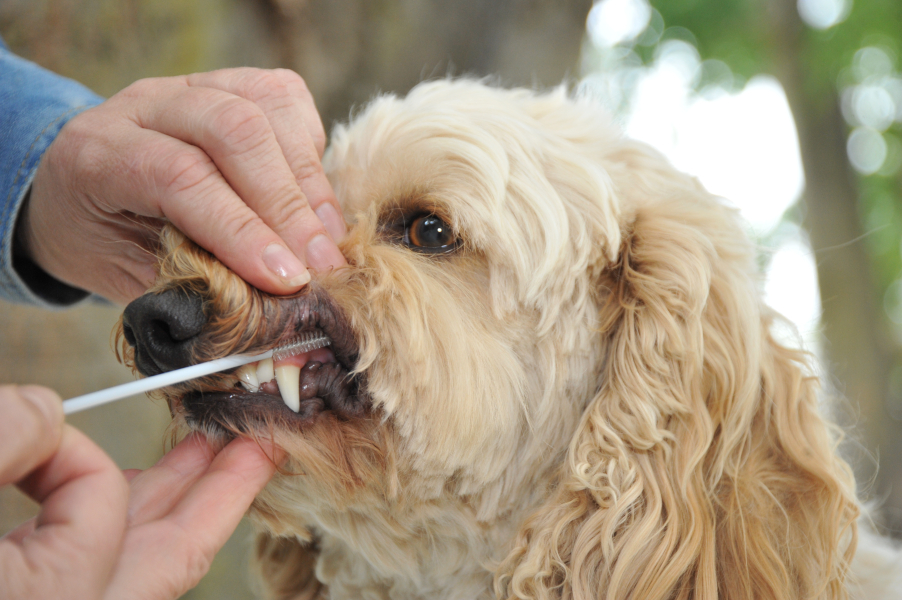
Step-By-Step:
- Make sure the dog has not had anything to eat or drink for at least 1 hour prior to collecting sample.
- When swabbing puppies, isolate each puppy from the mother, littermates and any shared toys for 1 hour prior to swabbing. Puppies should not have nursed or eaten for 1 hour prior to collecting sample.
- If collecting samples from more than one dog, make sure to sample one dog at a time and wash your hands before swabbing another dog.
- Label brush sleeve with name or ID of dog to be sampled.
- Open brush sleeve by arrow and remove one brush by its handle.
- Place bristle head between the dog’s gums and cheek and press lightly on the outside of the cheek while rubbing or rotating the brush back and forth for 15 seconds.
- Wave the brush in the air for 20 seconds to air dry.
- Insert brush back into sleeve.
- Repeat steps 5 - 8 for each unused brush in sleeve on a fresh area of cheek and gums. Make sure to use and return all 6 brushes sent by the VGL.
- Do not seal brushes in sleeve.
- Place all samples in an envelope and return to the address provided.
ATTENTION:
- Do not collect saliva/drool – the key to obtaining a good sample is getting cheek cells on the swab
- Do not rub swab on the dog’s tongue or teeth – this will result in poor quality sample
- Do not collect a sample from a puppy that has recently nursed – the mother’s genetic material can rub off on the puppy’s mouth and contaminate the sample
Spinocerebellar ataxia (also known as cerebellar ataxia) is a progressive neurodegenerative disease that affects the Spinone Italiano. Affected puppies are normal at birth and begin showing signs of incoordination and loss of balance at about 4 months of age. Disorder progression occurs in the subsequent months, leading to a degree of dysfunction that causes dogs to be euthanized before one year of age.
Cerebellar ataxia (CA) in the Spinone Italiano is thought to be caused by an intronic GAA repeat expansion in the inositol 1,4,5-trisphosphate receptor, type 1 (ITPR1) gene. The condition is inherited in an autosomal recessive manner, meaning that two copies of the CA allele are needed to develop the disorder.
Testing recommendations: DNA testing for cerebellar ataxia can determine the genetic status of dogs. Dogs with one copy of the CA variant are normal but are carriers. Matings between two carrier dogs may, on average, produce 25% of puppies with cerebellar ataxia.