


Preferred Sample Types
All tests can be done using cheek swabs for cats and dogs and hair samples for horses, cattle, goats, pigs, and other livestock species, with the exception of the Freemartin test which requires a blood sample.
- Cheek Swab - Cats only
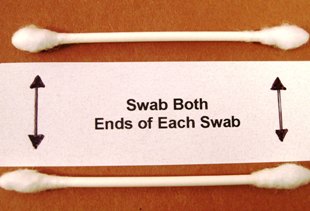
- You can purchase regular household cotton swabs at a pharmacy or drug store for DNA testing of cats only. The VGL requires 2 double-sided or 4 single sided cotton swabs per cat for testing. Please review our step-by-step instructions for collecting a good quality sample from cats.
- Cheek Swab - Dogs only
-
The VGL requires 3 cytology brushes or 4 interdental gum brushes per dog for testing.

ATTENTION: Please note that we cannot accept interdental gum brushes for all dog tests and some tests require the use of 6 cytology brushes per dog. Please visit the test page for your desired test for test-specific information about sample requirement.
Please review our step-by-step instructions for collecting a good quality sample from dogs.
- Hair Samples - Horses, Cattle, Goats, Sheep, Pigs and other livestock species
-
The VGL requires 20-40 hairs per animal for testing of horses, cattle, goats, pigs, sheep and other livestock species. Hairs must be pulled and sent with roots attached.
Please review our step-by-step instructions for collecting a good quality sample from these animals.
Long hairs can be taped to the submission form. For smaller hairs, please place the 20-40 hairs with roots in a paper envelope and label the envelope with the animal's name exactly as it appears in the order. Attach the envelope to the corresponding submission.DO NOT USE plastic bags as they can trap moisture and damage the sample.
Alternative Sample Types
The UC Davis VGL can also accept blood, fresh or frozen tissue, or semen samples for most tests offered. Please contact our customer service team to confirm we can accept these sample types for your desired test. There is no additional cost for testing blood, tissue or semen.
We strongly recommend sending these sample types via overnight or next day air delivery.
- Blood Samples
-
There is no additional cost for testing a blood sample.
-- Please note the following requirements that need to be met when submitting a blood sample:
-- Most species and testing require that you collect 2–3 mL of whole blood in a lavender/purple-top EDTA tube (exception of 1–2 mL for cats). Use an appropriately sized EDTA tube to ensure it can be properly filled, as maintaining the correct blood-to-additive ratio is essential.
--Ensure you have labeled the tube(s) with the animal's name exactly as it appears on the order form.
-- Place the tube(s) in a plastic bag with absorbent paper (for example, paper towel) and seal the bag.
-- Pack the blood well enough to withstand the rigors of shipping - shipping companies can return samples that are not appropriately packed and when these samples arrive in broken tubes, we are not able to test them. We recommend wrapping carefully with paper towels or bubble wrap around the tube for added protection.
-- Place sealed bag containing blood sample in a secondary shipping container and include an ice pack to keep the sample cool while in transit.
--Place accompanying paperwork (i.e. the order form) in a separate sealed plastic bag and remember to include it inside the shipment with the sample.
To avoid delays in processing and testing, we highly recommend sending the sample overnight through FedEx or UPS at the beginning of the week.
- Tissue Samples
- There is no additional cost for testing a fresh or frozen tissue sample.
-- Tissue samples from biopsy or harvesting should be kept frozen until ready to ship.
-- Please provide a 1-2 inch section of tissue from the spleen. The liver and kidney are also acceptable, although not optimal (if in doubt, send all three).
-- Place each tissue sample in a separate plastic bag or screw-cap tube (such as a 15 or 50ml falcon tube).
Do not add any liquid to the bag or tube!
-- Write the type of tissue and name of the animal (exactly as it appears on the order form) on the plastic bags/tubes.
-- Send the samples on ice, overnight, with the submission form via FedEx or UPS to the address listed below. The tissue sample does not need to arrive frozen.
-- If order was not prepaid online, please include the payment and payment information page with the sample. - Semen Samples
- There is no additional cost for testing a semen sample.
-- If the semen is stored in a straw, we prefer a full straw
-- If the semen is stored in pellets, we prefer 2-3 pellets
-- We are willing to test semen from used straws with a combined minimum volume of 75ul
-- Pack the semen straw well enough to withstand the rigors of shipping - these types of samples often arrive broken and we cannot test a broken sample.
-- Please include an ice pack to keep the sample cool while in transit. The semen does not need to arrive frozen. - For Deceased Animals
-
Hairs or cheek swabs collected after death are not accepted as they typically fail to yield sufficient DNA for testing.
If an animal is deceased, we can accept fresh or frozen tissue collected shortly after death (no additional cost) or bone/teeth samples for testing ($250 additional postmortem fee applies). Please see instructions for tissue samples above if sending tissue.
When sending teeth or clean bone samples for postmortem testing, please select the "postmortem sample" checkbox on the order form and follow the steps below.
-- The cost of the DNA extraction from bones and/or teeth is $250 plus the cost of any test selected.-- We accept teeth (optimal) or long bones for testing. For teeth, we prefer 4-6 molars with the jaw attached but remove excess tissue. For bones, please remove any excess tissue from the bone prior to sending.
-- The postmortem extraction process is very time-intensive, which is why the turnaround time for postmortem testing is typically 4-6 weeks.
-- Please note, while we have a high rate of success with postmortem samples, we are not able to guarantee a result. If we are not able to obtain a result from the sample, we cannot offer a refund.It is important that samples are submitted correctly so we are able to process them for testing. Ensuring the proper handling and shipping of samples increases the likelihood of a result.
Proper handling and shipping include:
- Please place the bone(s) and/or teeth in a plastic bag- Do not add any liquid to the bag!
- Write the name of the animal on the plastic bag(s) exactly as it appears on the order
- Send the samples on ice, overnight with the submission form via FedEx or UPS to the address listed below.
If order was not prepaid online, please include payment with the sample. If sending from outside the United States, a current import permit must accompany the sample.
Shipping Instructions
If sending from outside the United States, a current import permit must accompany the sample. The import permit will be provided with your sample submission form via email. If you opted to have the VGL send you cytology brushes for dog testing, the permit will be sent to you via US Priority mail together with your brushes.
For US Mail (USPS; includes priority and overnight):
Veterinary Genetics Laboratory
PO Box 1102
Davis, CA 95617-1102
For FedEx/UPS/DHL:
Veterinary Genetics Laboratory
University of California Davis
Old Davis Road (We do not have a numeric address, FedEx/UPS will need to override their system)
Davis, CA 95616
We accept FedEx and UPS shipments Monday – Friday