News

New American Quarter Horse Association Online Educational Resource for Equine Genetic Health

Understanding the results of genetic testing and how to best utilize them is an important component for advancing the health of animals. The American Quarter Horse Association (AQHA) recently formed a task force consisting of veterinarians, geneticists, AQHA staff and AQHA members, to assist in the development of an online resource to aid in the understanding and utilization of the results of genetic testing performed by the UC Davis Veterinary Genetics Laboratory (VGL). 

AQHA has added MYHM to the American Quarter Horse Genetic Health Panel offered through the Association

The American Quarter Horse Association (AQHA) has just announced that the myosin-heavy chain myopathy (MYHM) test has been added to the American Quarter Horse Genetic Health Panel offered through the Association. The decision to add MYHM was made earlier this year at the 2022 AQHA Convention in Las Vegas, NV, following a rule-change proposal submitted by an AQHA member. Starting December 1st, 2022, MYHM will be automatically included in the health panel test ordered through AQHA.

How genetic testing for MYHM helped Legend, a six year old American Quarter Horse

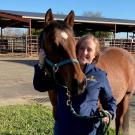
Legend, a 6-year-old American Quarter Horse, was showing signs of lethargy, loss of appetite, fever, dark urine, edema and muscle loss in the hindquarters. Soon after noticing a change in her horse, the concerned owner, Karissa Waber, decided to take him to her veterinarian for care. Legend was hospitalized for 8 days, but despite this care, his condition continued to worsen. In only a few days he developed colitis and signs of kidney failure. Nonetheless, Karissa’s veterinarian, Dr. Mem Dailey, was not ready to give up on Legend and started him on steroid treatments.

Variants associated with equine familial isolated hypoparathyroidism (EFIH) and fragile foal syndrome (FFS) are at low frequency in the US Thoroughbred population and are not recent mutations

The study led by Dr. Carrie Finno, Gregory L. Ferraro Endowed Director of the UC Davis Center for Equine Health (CEH), and Dr. Rebecca Bellone, Director of the Veterinary Genetics Laboratory (VGL), determined that the allele frequencies for equine familial isolated hypoparathyroidism (EFIH) and fragile foal syndrome (FFS) were low in a population of Thoroughbred horses.

New Test Available: Progressive Retinal Atrophy (rcd4-PRA)

Progressive retinal atrophy (PRA) is a term used to describe a group of inherited disorders of the retina, characterized by progressive retinal degeneration and consequent blindness. More than 20 mutations in various genes have been associated with PRA in dogs.

VGL Research identify risk factors for insidious uveitis in Knabstrupper horses

A study conducted by an international team of researchers led by VGL director, Dr. Rebecca Bellone, and with research performed by recent VGL Ph.D. recipient Nicole Kingsley, found that age and homozygosity for the leopard complex spotting allele (LP) are risk factors for insidious uveitis in the Knabstrupper horse. Genotyping for LP is, therefore, useful to assess risk and help inform clinical evaluations of equine recurrent uveitis in this breed.

VGL collaborative research investigates the prevalence of known genetic variants in horses with muscle disease

A collaborative study between the Neuromuscular Disease Laboratory and the Veterinary Genetics Laboratory at the University of California, Davis, showed that genetic variants known to cause skeletal muscle disorders were present in one third of horses with clinical diagnosis of muscle disease who were submitted for histopathological examination.

Dr. Aleman, Professor in the Department of Medicine and Epidemiology at UC Davis, an expert in neuromuscular biology and lead investigator of this study noted:

VGL Research: Heritability of insidious uveitis in the Appaloosa horse

The VGL equine genetics research team, led by Dr. Rebecca Bellone, has just published a new study on the heritability of insidious uveitis in the Appaloosa horse.

The study evaluated over 140 horses and the findings show that ERU is highly heritable in this breed. This study was the focus of Dr. Nicole Kingsley’s Ph.D. thesis work and is the first of several studies on the genetics of uveitis to be conducted as part of  Nicole’s thesis project.